BC
BC





March 19, 2026 | British Columbia
If you are searching for how to become a Certified Dental Assistant (CDA) in BC, there has been an important terminology change.
As of April 1, 2026, the BC College of Oral Health Professionals (BCCOHP) uses Licensed Dental Assistant (LDA)* as the licence category. Certified Dental Assistant was the previous designation.
For students interested in a hands-on healthcare career without spending several years in university, dental assisting offers a relatively direct training pathway. This guide explains the current education, NDAEB and BCCOHP requirements for becoming an LDA in British Columbia.
Is Dental Assisting Regulated in British Columbia?
Yes, but there is an important distinction.
In BC, you may see two types of dental assistants:
- Chairside Dental Assistant: Does not hold an LDA licence. Certain duties may be performed when applicable training, delegation and supervision requirements are met.
- Licensed Dental Assistant (LDA): Holds an active BCCOHP licence and can be delegated a broader range of clinical services.
For many students, licensure is the goal because it can open the door to a broader range of clinical responsibilities and dental assisting opportunities.
Learn more in Licensed vs. Chairside Dental Assistant in BC: What's the Difference?.
Steps to Become a Licensed Dental Assistant in BC
The LDA pathway follows several key stages.
Step 1: Complete an Accredited Dental Assisting Program
One direct pathway is to graduate from a dental assisting program accredited by the Commission on Dental Accreditation of Canada (CDAC).
Dental assisting training typically covers areas such as:
- Dental anatomy and physiology
- Infection prevention and control
- Dental radiography
- Chairside assisting
- Dental materials
- Intra-oral dental assisting
- Patient care and communication
CDI College's Dental Assisting Diploma Program in Burnaby and Surrey is 55 weeks and CDAC-accredited. Accreditation is particularly important because graduates of accredited programs can proceed to the applicable NDAEB examination requirements.
Step 2: Pass the NDAEB Examination
After graduating from a CDAC-accredited program, students can apply to write the NDAEB Theory Examination.
The National Dental Assisting Examining Board assesses whether candidates meet the national standard for dental assisting.
Since January 1, 2026, candidates who did not graduate from a CDAC-accredited program may need to complete the Clinical Practice Evaluation before becoming eligible for the Theory Examination, subject to applicable transition provisions.
Bonus Read: How to Pass the NDAEB Exam: Tips and Study Strategies
Step 3: Apply for an LDA Licence With BCCOHP
After meeting the applicable education and NDAEB requirements, graduates apply to BCCOHP for an LDA licence.
The application process can include:
- Proof of dental assisting education
- NDAEB Certificate
- Government-issued identification
- Criminal record check
- Applicable application and licence fees
Graduates cannot practise as an LDA until their licence has been confirmed by BCCOHP.
Step 4: Maintain Your LDA Licence
Once licensed, LDAs must renew their BCCOHP licence according to the regulator's requirements.
BCCOHP also introduced a modernized Quality Assurance Program (QAP) in April 2026. The program supports ongoing professional competence.
Bonus Read: BCCOHP and NDAEB: How Dental Assistants Get Licensed in BC
Why Choose Dental Assisting as a Career?
Dental assisting can appeal to students looking for practical healthcare training without a long academic timeline.
Faster Entry Into Healthcare
CDI College's Dental Assisting diploma program can be completed in 55 weeks, which is shorter than many three- or four-year degree programs.
Graduates pursuing LDA status must then complete the applicable NDAEB and BCCOHP licensing steps.
Hands-On Work in a Clinical Setting
Dental assisting involves practical work throughout the day.
Students preparing for the field can develop experience in patient care, chairside assisting, dental materials, radiography, infection control and other clinical procedures.
This may appeal to people who prefer learning and working in a hands-on environment.
Lower Education Costs Compared to University
A shorter career-focused program generally means spending fewer years in school than a traditional university degree. Actual education costs vary, so students should compare tuition, funding options, program length and the credential required for their career goals before deciding.
Dental Assistant Job Outlook in BC
WorkBC forecasts 3,130 job openings between 2025 and 2035 across BC.
The largest forecast totals are in Mainland/Southwest, Vancouver Island/Coast and Thompson-Okanagan, while WorkBC expects demand for dental assistants to remain strong.
A Strong Fit for Recent High School Graduates
Dental assisting can provide a defined route from high school into career-focused healthcare training without requiring a university degree. For students who want a more clinically involved role, the LDA pathway adds accredited training, national examination requirements and professional licensure.
Dental Assistant Salary and Job Outlook in BC
Dental assisting remains an established occupation within BC's healthcare workforce.
Job Outlook
WorkBC forecasts 3,130 job openings between 2025 and 2035 for Dental Assistants and Dental Laboratory Assistants in BC.
WorkBC also expects demand for dental assistants to remain strong. The largest numbers of forecast openings are concentrated in:
- Mainland/Southwest: 2,110 openings
- Vancouver Island/Coast: 450 openings
- Thompson-Okanagan: 320 openings
This means some of the strongest opportunities are expected around the Lower Mainland, Vancouver Island and Okanagan regions.
For a closer look at the labour market, read Are Dental Assistants in Demand in British Columbia?.
Salary Range
According to Job Bank's wage data for dental assistants in BC:
- Low: $24 per hour
- Median: $31 per hour
- High: $36 per hour
For someone working 40 hours per week throughout the year, this equals roughly $49,900 to $74,900 per year, before factors such as overtime, unpaid time off or differences in weekly hours.
Licensed dental assistants can work in:
- General dental clinics
- Orthodontic offices
- Community health centres
- Specialty dental practices
Bonus Read: How Much Do Dental Assistants Make in BC?
What to Look for in a Dental Assisting Program in BC
When comparing programs, consider:
- CDAC Accreditation: Check whether the program is accredited by the Commission on Dental Accreditation of Canada.
- NDAEB Preparation: Look for training that prepares students for the knowledge and competencies assessed by the NDAEB.
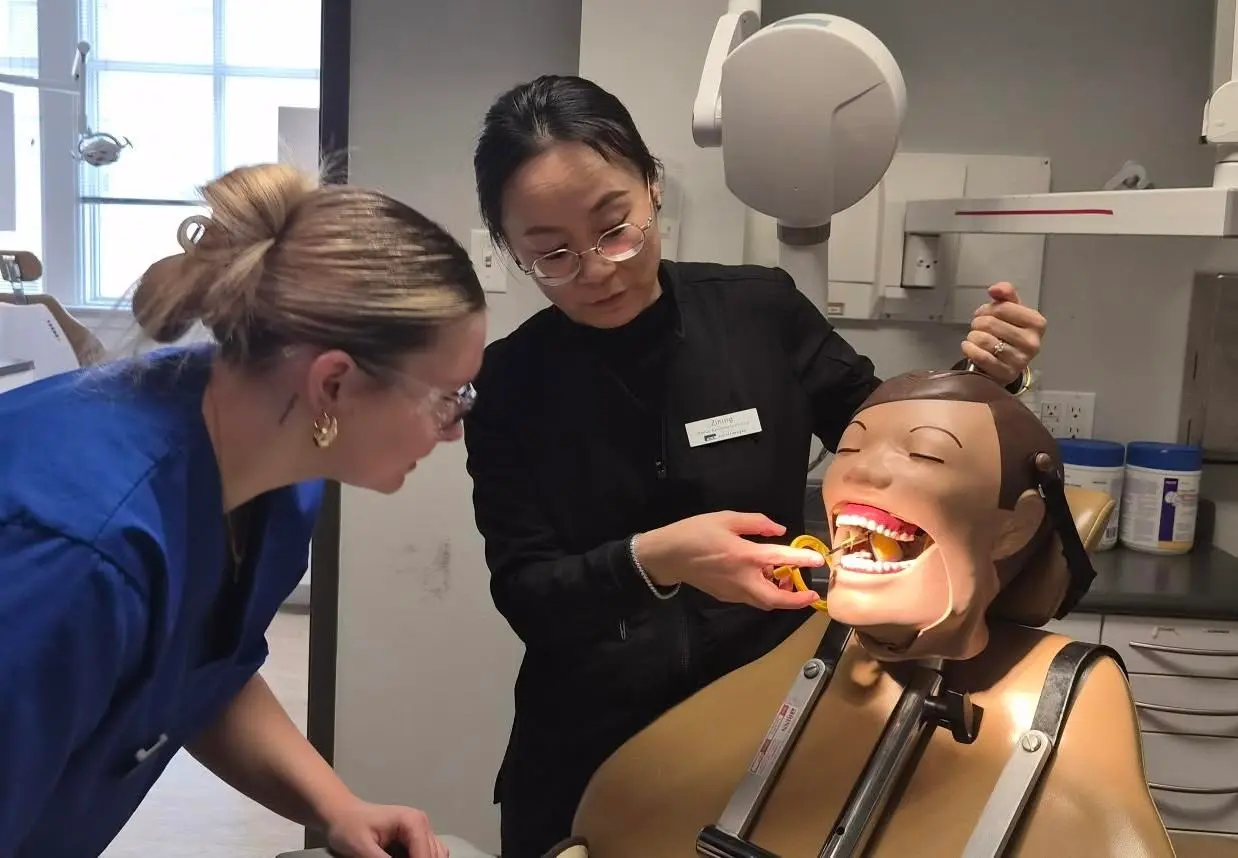
- Clinical Training: Dental assisting is hands-on, so laboratory and clinical practice should be an important part of your education.
- Practical Experience: Outside practical experience can help you apply classroom and clinical skills in an actual dental workplace.
- Program Length: Consider both the length of the program and the additional time required for the NDAEB and BCCOHP licensing process.
For a clearer timeline, read How Long Does It Take to Become a Dental Assistant in BC?.
CDI College Dental Assisting Program in BC
CDI College's Dental Assisting diploma program is designed to prepare students for the educational stage of the LDA pathway.
Program Overview
- Duration: 55 weeks
- Delivery: In person
- Locations: Burnaby and Surrey
- Accreditation: CDAC-accredited
- Provincial approval: Approved by the Registrar of PTIRU
Key Features of CDI College Dental Assisting
615 Hours of Clinical and Practical Training
The program combines on-campus clinical training with experience in dental workplaces:
- 440 hours of on-campus clinical training
- 175 hours of mandatory outside practical experience
The outside practical experience includes 75 hours in Phase I and 100 hours in Phase II.
This gives students opportunities to practise dental assisting procedures before applying their training in an external dental practice.
Job-Ready Skills
Students develop practical skills in areas such as:
- Chairside dental assisting
- Dental radiography
- Infection prevention and control
- Dental materials
- Intra-oral procedures
- Patient records and dental office processes
The goal is to connect classroom knowledge with the procedures and workflows students may encounter in dental settings.
Career Preparation Support
CDI College also provides career preparation that can include:
- Resume and cover letter support
- Interview preparation
- Job-search guidance
- Workplace expectations
This support helps students prepare for the transition from training to employment.
Reported Outcomes
Recent CDI College Dental Assisting results include:
- 97% employment rate for the BC program from January to December 2025
- 100% NDAEB pass rate for students from both Burnaby and Surrey in the June 2025 sitting
These results provide recent indicators of student and program outcomes. Graduates must still meet applicable NDAEB requirements and complete BCCOHP's licensing process before practising as LDAs.
Where CDI College Fits Into Your Career Path
Choosing the right program can make the transition from training to the LDA pathway easier to understand.
How Quickly Can I Start Working?
CDI College's Dental Assisting diploma program takes 55 weeks to complete.
Graduates who want to practise as LDAs must then complete the applicable NDAEB requirements and receive their BCCOHP licence before providing LDA services.
Will I Gain Real Clinical Experience?
The program includes 615 hours of clinical and practical training:
- 440 hours on campus
- 175 hours of outside practical experience
This allows students to practise dental assisting skills in a learning environment before applying them in dental workplaces.
Is the Program Aligned With LDA Licensure Requirements?
CDI College's Dental Assisting diploma program is CDAC-accredited, and graduates are eligible to apply for the NDAEB examination.
The pathway is:
- Graduate from the accredited dental assisting program
- Meet NDAEB requirements
- Obtain the NDAEB Certificate
- Apply to BCCOHP for LDA licensure
The college provides the education that supports the pathway, while the NDAEB and BCCOHP independently administer their examination, credential and licensing requirements.
Structured Path from Training to Licensure
For students pursuing the LDA route, the pathway can be summarized as:
- Complete the 55-week Dental Assisting diploma
- Build skills through 615 hours of clinical and practical training
- Complete applicable NDAEB requirements
- Apply for an LDA licence with BCCOHP
- Begin searching for dental assisting opportunities
This gives students a clear sequence from education to professional licensure and employment preparation.
Final Thoughts
Becoming a Licensed Dental Assistant in BC follows a defined pathway: complete the right training, meet NDAEB requirements and obtain a BCCOHP licence.
If you want hands-on healthcare training and the opportunity to develop a broader range of clinical dental assisting skills, CDI College's Dental Assisting Diploma Program in Burnaby and Surrey can provide the educational foundation for the LDA pathway.
Request more information for availability, details and financial options.
* As of April 1, 2026, BCCOHP uses Licensed Dental Assistant (LDA) as the licence category. The previous designation was Certified Dental Assistant (CDA).